Rel McCoy
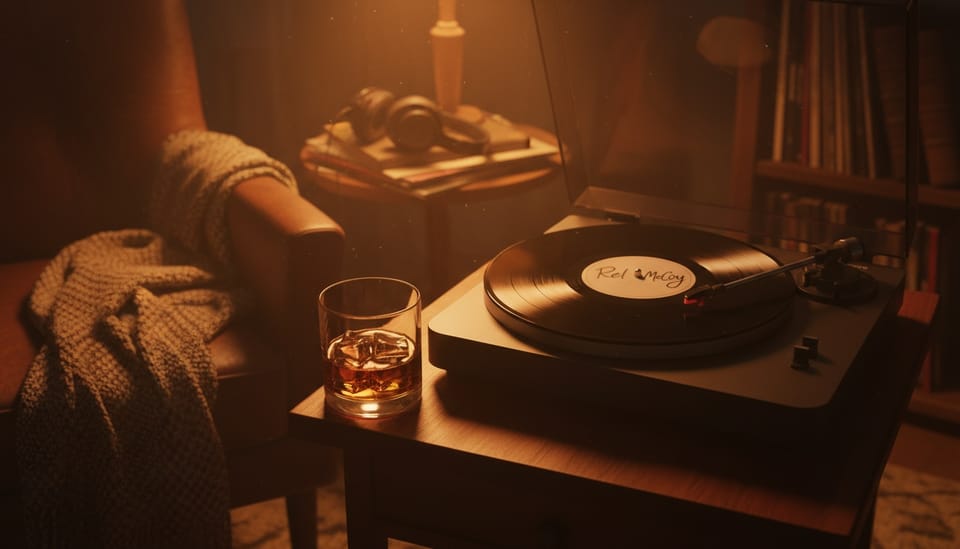
Before we start, pour yourself a glass of Maker’s Mark on ice. Maker’s has been doing the same thing for a long time and doing it well. Warm nose, soft wheat, a little vanilla, a clean finish. Nothing loud. Nothing dressed up. Just steady craft that shows up the same way every time. That pace made sense once we got to know Rel.
We first saw him on Instagram. The sound pulled us in before the caption did. Clean flow, real bars, a 90s feel without pretending it was the 90s. He produces his own work, engineers it, shapes it, and you can hear the years in his tone. We believe the best way to understand an artist like that was to ask him directly, so we sent him a few questions. What came back made us appreciate the music even more. We hope you learn and appreciate Rel and his journey as much as we do.
Here’s what he had to say:
1. When you moved from Toronto to Spain in 2020, how did that shift your creative rhythm? Was it a reset, an exit, or something else entirely?
“It felt like an exit and really became a reset for me personally and musically. We moved here so we could be closer to my wife's mother who is experiencing some health problems. It was one of those decisions that I just knew was the right thing to do, and didn't really give my music a whole lot of thought. It was dope that the change of scenery, the change of pace and lifestyle really gave me some breathing room to be creative. It was a pleasant surprise. The album, The Tiger The Sparrow The Koi and The Chameleon, was born in that new creative space.”
2. You’ve played shows across four continents. Which city changed your live set the most, and what did it teach you?
“I really gotta say that Toronto is the best place for a hip hop artist to be forged. It is a tough audience, and there is no fooling T.O. If you can make even a little mark there, I think you are good. Every city I played taught me something new, not just with the performance, but with how to engage with promoters and engineers, venue owners and fans in a better way. A lot of the influence came from the touring partners. Ghettosocks, Fresh Kils, Uncle Fester, Ambition, RationaL, and more.”
3. Miles to Go marked a shift. Since then, which collaboration or studio moment has stuck with you creatively?
“Yeah, that album definitely was a transitional place for me. It is weird because I feel like with every record I make I am finding out that I am still finding my footing. It feels like there is this weird treasure deep inside me that I have to dig up with each one. Working with Shad, Thrust, Wio-K, and Moka Only has been life-changing for me. Everyone has their process, and I think I have picked up something from each one.”
4. You’ve always moved outside industry lanes. Is there still a milestone you’re chasing, or one you let go of?
“It really is a consistent fight to be my true self and not be distracted by what the world tells me to pursue. Especially as hip hop artists we are always having to duck the trappings of chasing money or fame or women, or even the way that we tend to find our personal value in how people perceive us. I have seen a lot of great artists come and go, and usually the reason they go is because this is not a place for true artists to make decent money or even pay the bills. I have been doing this for a long time and I am still working at making it a truly sustainable thing. If I had not had producing and engineering and the grant funding in Canada, I do not know that I would be here right now doing what I am doing.”
5. You came up when hustle meant posters, handoffs, and late-night radio. Do you think that kind of grind still matters in a metrics-first world?
“A big part of me wishes it still mattered like it used to because I felt like I was just getting used to the idea of pounding the pavement when it dried up. Either way, marketing is tough for someone whose soul is in creativity and not metrics. I am still pushing through and finding meaningful ways to connect with hip hop fans. I have learned a lot, but I feel like I am only at the tip of the iceberg. I think I would be wrong to say street team work is totally obsolete, but artists are better off spending their time and money figuring out digital marketing.”
6. You write, produce, mix, and engineer your own work. Which part of that process costs you the most, and which part gives you back the most?
“I wish I had a clear-cut answer. I usually ask which part is most important to tackle today. Writing is the most time consuming but probably the most rewarding. I believe our legacy is in the words we speak and how we speak them. I do not think I have ever written a song where it was not a new challenge, and there is always this personal bet with myself that I can outdo the last one. When Common said, ‘I spend a lot of time with the rhyme,’ I think I took that literally. That line pops up every time I pick up the pen.”
7. Outside of hip hop, what sounds or disciplines shape your work now?
“I am entrenched in music in one way or another. Outside of that I love movies and books, although reading about geopolitics or economics does not influence my music much. Sonically I find things digging around on YouTube. I am sure everything influences something, even if the approach stays the same.”
8. You’ve crowdfunded albums, released independently, and built your own lane. What defines success for you now?
“I look at it like I have built a lane on a pathway carved out by artists who came before me and some who are still pushing through. Success now is any sense of sustainability I can bring to the table. I get distracted, and I have to remind myself the goal is to connect with people, not chase some finish line. Being present matters.”
9. Your music often feels reflective but not curated. When you create, what leads the process? Instinct, memory, or something else?
“I heard someone say that fools wait for inspiration and creators get to work. That is probably the best description of my process. Inspiration shows up in small doses. My notes app and voice recordings are full. Every now and then something stands out enough to flesh out.”
10. You’ve worked with artists like Eternia, Moka Only, and RationaL. What separates the ones who last from the ones who fade?
“Resilience. Persistence. Consistency. You have to accept who you are and work with what you have. I am ready to fade once or twice a month, but I do not listen to that voice. I do not know how to do much else. This is who I am.”
11. You’ve said there are still miles to go. What’s a sound or format you have not explored yet but want to?
“I do not really know what that looks like. I want to be innovative, but I know my lane. I follow my conscience. Sometimes I listen back to old material and surprise myself. I would not mind doing creative writing outside of music, but time does not allow for it right now.”
12. If your sound aged in a barrel, what would it pour out as?
“Makers Mark on ice. Cold and ready to wake your ass up. At this point I guess I better say twenty years. Let us see what pours out this year.”
13. What was the last record you listened to all the way through?
“Joe Budden, Rage and the Machine. Me and RationaL ran that one over and over driving through western Canada.”
14. What’s one bar, yours or someone else’s, that still makes you pause?
“Shad. Cats say I am the illest…”
When you sit with Rel’s answers, what you feel is that nothing about him is rushed. Nothing is postured. He has been doing this long enough that he does not need noise around it. Spain was not reinvention. It was life happening, and the music settled into that. Toronto is still in him. You can hear it in the way he talks about crowds and the early grind. He is not chasing a moment. He is committed to the work. He knows how hard it is to stay in it and how many artists tap out because the industry does not make room for them. The reason he is still standing is because he built the skill set to hold himself up. Producing, engineering, writing. He is not romantic about it. He just works and trusts that something will come from it. That consistency stood out more than anything.
As you see, Rel picked Maker’s on ice, and it fits. Not as symbolism, just as a pace. Slow, steady, dependable. He is not chasing whatever is trending. He is focused on staying sharp and grounded in the life he is actually living. Talking to him confirmed what we heard in the music the first time. The 90s feel, the grit, the clarity. Not nostalgia. Not imitation. Just someone with real skill who keeps building and does not lose the thread.
Want More?
If you want to hear the bar that stuck with him, listen to Shad “The Old Prince Still Lives at Home”.
If you want to go deeper into Rel’s work, you can find him on Instagram and hear his latest album The Tiger The Sparrow The Koi and The Chameleon.